

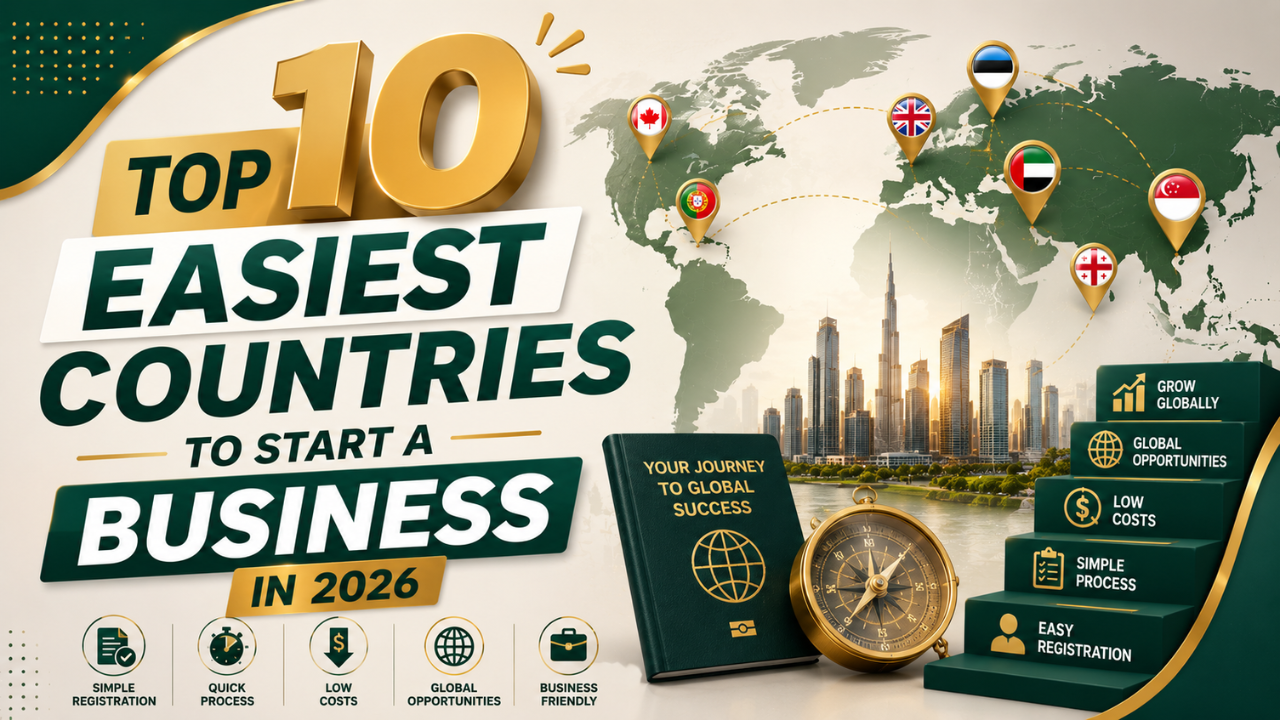
Choosing where to incorporate is one of the most consequential decisions an entrepreneur makes. The wrong jurisdiction can mean months of bureaucratic delay, unexpected tax exposure, restricted banking access, or limited ability to attract international investors. The right jurisdiction accelerates everything from your first invoice to your first institutional funding round.
The easiest countries to start a business share a common set of characteristics: digital registration systems, low or transparent taxation, accessible banking infrastructure, and legal frameworks that protect foreign ownership. In 2026, these factors matter more than ever. Cross-border commerce has normalised, remote teams are the standard, and investors increasingly evaluate the regulatory jurisdiction of a business before they evaluate the product.
This article examines the top 10 easiest countries to start a business in 2026, with practical detail on costs, timelines, tax structures, and what each country offers to founders, investors, and international operators. It also explains why the UAE and Dubai in particular continues to lead for businesses seeking a genuinely global operational base.
What Are the Easiest Countries to Start a Business?
The easiest countries to start a business are jurisdictions where the legal, administrative, and financial requirements for company formation are minimal, transparent, and fast. This includes countries where registration can be completed online within days, where foreign nationals can own 100% of a company without a local partner, where the tax system is simple and rates are competitive, and where banking access for new businesses is reliable. Rankings are typically drawn from the World Bank’s Doing Business indicators, the OECD, and independent analyses of incorporation speed, cost, and post-registration compliance burden.
Overview: Which Countries Make Business Formation the Simplest?
The easiest countries to start a business in 2026 are those that have actively invested in reducing friction for entrepreneurs both domestic and international.
Here is the ranked overview:
1. UAE (United Arab Emirates)- Company formation in UAE free zones takes as few as three business days. Foreign nationals own 100% of their business, pay zero personal income tax, and access over 130 double taxation treaties. The UAE consistently ranks first among Middle Eastern and African markets for ease of doing business.
2. Singapore- allows online company registration in under an hour through the Accounting and Corporate Regulatory Authority (ACRA) portal. Corporate tax is capped at 17%, with significant exemptions for startups in the first three years.
3. Estonia- Through its e-Residency program, Estonia allows non-residents to register a company entirely online without visiting the country. The country operates a deferred corporate tax system profits are taxed only when distributed, not when earned.
4. United Kingdom- UK company formation through Companies House takes less than 24 hours online and costs £50. The UK has one of the world’s most liquid capital markets, a mature legal system, and strong investor infrastructure.
5. United States (Delaware / Wyoming)- While US federal registration is complex, Delaware and Wyoming have become global incorporation benchmarks. Delaware alone is home to over 60% of Fortune 500 companies due to its business-friendly courts and flexible corporate statutes.
6. New Zealand- New Zealand regularly ranks first or second in World Bank Doing Business reports. A company can be registered in under an hour through the Companies Office online portal, with no minimum share capital required.
7. Canada- Canada offers straightforward federal or provincial incorporation, a stable currency, strong banking infrastructure, and a progressive immigration pathway for founder visas and startup permits.
8. Georgia (Country)- Georgia has become one of the most underrated of the easiest countries to start a business, with a flat 1% turnover tax for small businesses, fast online registration, and a strategically important location between Europe and Central Asia.
9. Hong Kong- Hong Kong maintains zero tax on offshore income, a territorial tax system, and a well-established legal framework based on English common law. Company registration typically completes within one to three days.
10. Ireland- Ireland’s 12.5% corporate tax rate, EU membership, English-speaking workforce, and strong technology sector make it the preferred European base for US companies and a consistent entry on every list of the easiest countries to start a business.
Why the Easiest Countries to Start a Business Matter for Entrepreneurs and Investors
The question of where to register a company is not merely administrative; it directly affects profitability, scalability, and investment readiness.
Research consistently shows that companies registered in business-friendly jurisdictions raise capital faster, expand internationally with fewer barriers, and attract higher-quality talent. The compliance burden in a poorly ranked jurisdiction can consume 15 to 20% of a founder’s annual working time in regulatory administration alone.
For investors, jurisdiction matters at due diligence. Venture capital firms and private equity houses routinely prefer companies incorporated in jurisdictions with clear legal structures, enforceable shareholder agreements, and predictable tax treatment. A startup incorporated in Singapore or the UAE often faces fewer investor objections than one in a market with opaque regulatory systems.
The global market for cross-border business formation is also growing rapidly. Over 40,000 companies per year use Estonia’s e-Residency program. The UAE processed over 150,000 new business registrations in 2023. This is not speculation, it reflects a measurable trend of entrepreneurs selecting jurisdiction strategically rather than defaulting to their home country.
For companies with global ambitions, selecting one of the easiest countries to start a business is the first and most durable competitive advantage available before a single product is sold.
Step-by-Step Process: How to Register a Business in the Top Jurisdictions
The general process for registering in any of the easiest countries to start a business follows a consistent sequence, with jurisdiction-specific variations at each stage.
Step 1: Define Your Business Structure
Before selecting a country, clarify what your company will do, who owns it, where your customers are, and where your revenue will flow. These factors determine the optimal jurisdiction. A software company selling globally has different needs from a logistics firm serving the Middle East.
Step 2: Select Your Jurisdiction
Compare jurisdictions on five criteria: incorporation speed, ownership rules, tax rate, banking accessibility, and visa options. Use this comparison alongside your business model. If physical presence matters, UAE or Singapore may lead. If digital-only is sufficient, Estonia is compelling.
Step 3: Choose Your Business Structure
Each country has its own entity types. In the UAE, the primary options are LLC (mainland) or FZ-LLC (free zone). In the UK, a Private Limited Company (Ltd) is standard. In the US, a Delaware C-Corp is preferred for VC-backed startups. In Singapore, a Private Limited Company (Pte. Ltd.) is the norm.
Step 4: Reserve Your Company Name
Most jurisdictions require name reservation or a name availability check before registration. This is typically done online and takes minutes to hours.
Step 5: Prepare and Submit Documentation
Documentation requirements vary but generally include: passport copies of all shareholders and directors, a registered address in the country of incorporation, Memorandum and Articles of Association, and a business activity declaration.
Step 6: Pay Registration Fees
Government registration fees range from £50 in the UK to AED 15,000–50,000 in UAE free zones, depending on the jurisdiction and license type. These fees are paid at the point of application.
Step 7: Receive Certificate of Incorporation
Once approved, you receive your Certificate of Incorporation (or equivalent). This document legally authorises your company to operate and is required for all subsequent steps.
Step 8: Open a Corporate Bank Account
Banking is often the most time-consuming step. UAE banks require detailed documentation and may take two to six weeks. UK challenger banks like Tide or Starling can onboard companies within days. Singapore banks typically complete in one to two weeks.
Step 9: Register for Taxes In the UAE, register for corporate tax and VAT if applicable. In the UK, register for Corporation Tax within three months of starting business. In Singapore, GST registration is required when turnover exceeds SGD 1 million.
Step 10: Maintain Ongoing Compliance
Annual returns, financial statements, tax filings, and license renewals are ongoing obligations in every jurisdiction. Build a compliance calendar from day one to avoid penalties.
Costs, Timelines, and Requirements by Country
| Country | Registration Cost | Timeline | Foreign Ownership | Notes |
| UAE (Free Zone) | AED 15,000 – 50,000 | 3 – 7 days | 100% | Includes license and flexi-desk |
| Singapore | SGD 315 (~USD 235) | Under 1 hour | 100% | ACRA online portal |
| Estonia (e-Residency) | €265 – €380 | 3 – 5 weeks | 100% | Card pickup required at embassy |
| United Kingdom | £50 | Under 24 hours | 100% | Companies House online |
| USA (Delaware) | USD 90 – $500 | 1 – 5 days | 100% | Registered agent required |
| New Zealand | NZD 115 (~USD 70) | Under 1 hour | 100% | Online via Companies Office |
| Canada (Federal) | CAD 200 (~USD 150) | 1 – 5 days | 100% | NUANS name search required |
| Georgia | GEL 100 (~USD 37) | 1 – 2 days | 100% | One of the lowest costs globally |
| Hong Kong | HKD 1,545 (~USD 200) | 1 – 3 days | 100% | Company Secretary required |
| Ireland | €50 – €100 | 3 – 5 days | 100% | CRO online registration |
Benefits and Advantages of Registering in the Easiest Countries to Start a Business
- Speed to market: In top-ranked jurisdictions, a legally operational company can exist within hours of submitting an application. This eliminates the months-long delay common in less streamlined markets.
- Full foreign ownership: Every country on this list allows 100% foreign ownership without requiring a local partner or nominee shareholder. This protects founders’ equity and decision-making authority.
- Competitive tax structures: From Estonia’s deferred tax model to Georgia’s 1% turnover option and the UAE’s 0% personal income tax, these jurisdictions are designed to retain value inside the business rather than extract it through the tax system.
- Investor credibility: Companies incorporated in Singapore, Delaware, the UK, or the UAE carry structural credibility with venture capital funds, angel investors, and institutional partners who are familiar with these legal frameworks.
- Banking access: The easiest countries to start a business also tend to have the strongest banking infrastructure, both traditional and digital. Multi-currency accounts, SWIFT transfers, and real-time payment systems are standard.
- IP protection: All top-ranked jurisdictions have robust intellectual property frameworks, critical for technology, media, and pharmaceutical businesses that need to protect their core assets.
- Visa and residency pathways: The UAE investor visa, Singapore EntrePass, UK Innovator Founder Visa, and Canada Startup Visa all provide legal residency options linked to business ownership, a significant quality-of-life and operational advantage.
- Double taxation agreements: Each country on this list participates in an extensive network of double taxation treaties, reducing withholding taxes on dividends, royalties, and interest across borders.
Common Mistakes to Avoid When Choosing a Country to Start a Business
Choosing based on cost alone. The cheapest incorporation is rarely the best. Georgia at $37 is exceptional value if you are operating in that region. But if your investors, clients, and banking relationships are in the UAE or Singapore, a Georgian company may create friction that costs far more than you saved on registration.
Ignoring substance requirements. Tax authorities in your home country may require evidence of genuine economic activity in your chosen jurisdiction. Incorporating in a low-tax country while operating entirely from elsewhere can trigger controlled foreign corporation rules or permanent establishment claims.
Underestimating banking complexity. Many founders assume the bank account opens automatically after incorporation. It does not. Banking due diligence is a separate process with its own documentation requirements. Plan for it from the start.
Selecting the wrong entity type. A Delaware LLC works well for single-member operations but poorly for VC fundraising. A UAE mainland LLC is right for local trading but limits customs advantages available in free zones. Match the entity to the business model.
Neglecting ongoing compliance. Registration is the beginning, not the end. Annual returns, financial statements, and tax filings are legal obligations. Missing them creates penalties, deregistration risk, and reputational damage with banks and investors.
Failing to localise your contracts and terms. Contracts valid under one country’s law may not be enforceable in another. If you are trading internationally, ensure your agreements are governed by a jurisdiction whose courts will enforce them effectively.
Industry Trends in 2025–2026
Several structural shifts are redefining which countries qualify as the easiest countries to start a business and why entrepreneurs are choosing them.
Digital incorporation is becoming the global standard. The success of Estonia’s e-Residency program now used by over 100,000 e-residents has prompted other governments to digitise their registration infrastructure. The UAE, Singapore, and the UK have all invested significantly in digital government portals that process registrations in real time.
The UAE economy continues to diversify at pace. Non-oil sectors now account for over 70% of UAE GDP. The government’s Economic Agenda D33 targets doubling the size of the economy by 2033, creating sustained demand for business services, technology, logistics, and professional advisory firms. This makes the UAE not just an easy place to register, but a growing market to serve.
Global investors are prioritising jurisdiction transparency. Post-2022 regulatory tightening across the FATF (Financial Action Task Force) network has made banking due diligence more rigorous globally. Companies incorporated in well-regulated, FATF-compliant jurisdictions including all ten countries on this list face fewer banking obstacles than those in less transparent markets.
Startup visa programs are expanding. The UK’s Innovator Founder Visa, Canada’s Startup Visa, the UAE’s Entrepreneurial Residence Visa, and Singapore’s EntrePass are all being actively promoted as tools to attract international founders. This is shifting the conversation from “where to register” to “where to live and build.”
Remote-first companies are separating physical presence from operational base. More founders in 2025 and 2026 are choosing their incorporation jurisdiction independently of where they live. A founder based in Lagos may incorporate in the UAE. A founder in Berlin may choose Estonia. This decoupling of residency and registration jurisdiction is one of the defining business trends of the decade.
Why Dubai and the UAE Remain One of the Best Places for Business
Among the easiest countries to start a business in 2026, the UAE occupies a unique position. It is not merely easy to register; it is designed, at a policy level, to function as a global business hub.
Strategic location is the foundation. Dubai sits within a four-hour flight of over 2.5 billion people across the Middle East, Africa, South Asia, and Central Asia. Jebel Ali is the largest port in the Middle East. Al Maktoum International Airport is expanding to become the world’s largest. For businesses with physical products or regional operations, no other jurisdiction on this list matches this logistical position.
Tax benefits remain exceptional. Zero personal income tax, zero capital gains tax, zero withholding tax, and a 9% corporate tax rate on income above AED 375,000 combine to create one of the lowest effective tax burdens of any major economy. Free zone companies on qualifying income pay 0%.
Investor-friendly regulations have evolved significantly. The 2021 Companies Law removed the historic 51% local ownership requirement for most mainland activities. Today, foreign nationals can own 100% of mainland and free zone companies across the majority of commercial sectors.
Infrastructure quality is measurable. The UAE ranks in the top five globally for telecommunications, logistics performance, and financial services infrastructure. The government’s digital services from visa applications to tax filings are among the most advanced in the world.
For any entrepreneur evaluating the easiest countries to start a business with a view to scaling internationally, the UAE remains the single jurisdiction that combines the largest number of advantages without significant trade-offs.
Expert Insight
Selecting a jurisdiction for incorporation is a strategic decision with a five to ten year time horizon; it should not be made based on a single factor like cost or registration speed alone. The most durable choice is a jurisdiction where your banking relationships, your investor network, your visa status, and your tax position all reinforce each other.
The UAE does this exceptionally well for businesses with international ambitions, because its infrastructure, regulatory environment, and geographic position were all built with global commerce in mind. Founders who invest the time to structure their business correctly from day one choosing the right jurisdiction, the right entity type, and the right compliance framework consistently outperform those who treat incorporation as an afterthought.
How AB Capital Services Supports Business Setup
AB Capital Services provides end-to-end support for entrepreneurs choosing the UAE as their base from the easiest countries to start a business in 2026. Their team manages every stage of the setup process, removing the administrative complexity that typically slows international founders.
AB Capital assists clients with:
- Company formation in UAE mainland and all major free zones, including activity selection, documentation, and authority liaison
- Investor visas and residency for shareholders, directors, and their families, covering Emirates ID and medical processing
- Corporate bank account assistance, including institution selection, documentation preparation, and relationship support with UAE and international banks
- Tax registration and compliance, covering both VAT and corporate tax registration with the Federal Tax Authority
- Accounting and advisory services, including bookkeeping, financial statement preparation, and ongoing regulatory compliance
AB Capital is known for fast turnaround times and transparent pricing, making them the practical choice for international entrepreneurs who need to establish a UAE presence efficiently and correctly from the outset.
AB Capital Contact Details
AB Capital Personalize Business Solutions
Head Office: Office No. 404 Al Tawhidi Building Bank Street Bur Dubai, UAE
UK Address: Unit 6, Abenglen Industrial Estate Betam Road Hayes UB3 1SS London
Contact: +971 58 561 9500
Email: info@abcapital.ae
Key Takeaways
- The easiest countries to start a business in 2026 are the UAE, Singapore, Estonia, the UK, the USA (Delaware), New Zealand, Canada, Georgia, Hong Kong, and Ireland.
- All ten countries allow 100% foreign ownership without requiring a local partner or nominee shareholder.
- Registration timelines range from under one hour (Singapore, New Zealand) to three to seven days (UAE free zones), making company formation faster than ever.
- Tax efficiency varies significantly from Estonia’s deferred tax model to the UAE’s 0% personal income tax and 9% corporate rate on qualifying income.
- Banking setup is consistently the most time-consuming step and should be planned from the day of incorporation, not after.
- Jurisdiction choice should align with your business model, investor expectations, residency needs, and long-term tax position not just registration cost.
- The UAE leads for businesses with regional ambitions across the Middle East, Africa, and South Asia, combining strategic location with world-class infrastructure and regulatory clarity.
- Professional advisory support at the setup stage prevents the compliance errors and structural mistakes that are expensive to correct later.
FAQs
Q1: Which are the easiest countries to start a business in 2026?
The easiest countries to start a business in 2026 include the UAE, Singapore, Estonia, the United Kingdom, the United States (Delaware), New Zealand, Canada, Georgia, Hong Kong, and Ireland. These jurisdictions rank highest for registration speed, foreign ownership rights, tax transparency, and access to corporate banking.
Q2: How fast can you register a company in the easiest countries to start a business?
Registration timelines vary by country. Singapore and New Zealand allow online registration in under one hour. The UK processes applications within 24 hours. UAE free zone companies are typically registered within three to seven business days. Georgia and Hong Kong typically complete registration within one to three days.
Q3: Can a foreigner own 100% of a company in these countries?
Yes. All ten of the easiest countries to start a business on this list allow 100% foreign ownership without requiring a local partner, nominee director, or minimum local shareholding. The UAE extended 100% foreign ownership to most mainland sectors in 2021.
Q4: What is the cheapest country to start a business in 2026?
Georgia is among the cheapest, with registration costing approximately USD 37. New Zealand costs around USD 70, and the UK costs £50. However, the total cost of doing business including banking, compliance, and tax matters more than the registration fee alone.
Q5: Is the UAE one of the easiest countries to start a business?
Yes. The UAE is consistently ranked among the easiest countries to start a business globally. Free zone company formation takes three to seven business days, foreign nationals can own 100% of their company, and the UAE offers zero personal income tax, a straightforward corporate tax system, and one of the world’s most advanced digital government infrastructures.
Q6: What are the ongoing compliance requirements after registering in the easiest countries to start a business?
Ongoing requirements vary by jurisdiction but generally include: annual license or registration renewal, annual financial statements or tax returns, VAT or GST filing if the revenue threshold is met, and maintenance of a registered address. In the UAE, corporate tax registration is mandatory for all companies, and VAT registration is required above AED 375,000 in annual turnover.



I m agree with you